Perception and State Estimation for Autonomous Flight
Perception and State Estimation for Autonomous Flight
Perception and State Estimation for Autonomous Flight
Overview
This course focuses on how autonomous flight systems perceive the world and convert raw sensor data into stable, decision-ready state estimates. Building on the motion and control foundations from Track 2, students learn how perception, estimation, and control work together to enable reliable, vision-based autonomous behavior.
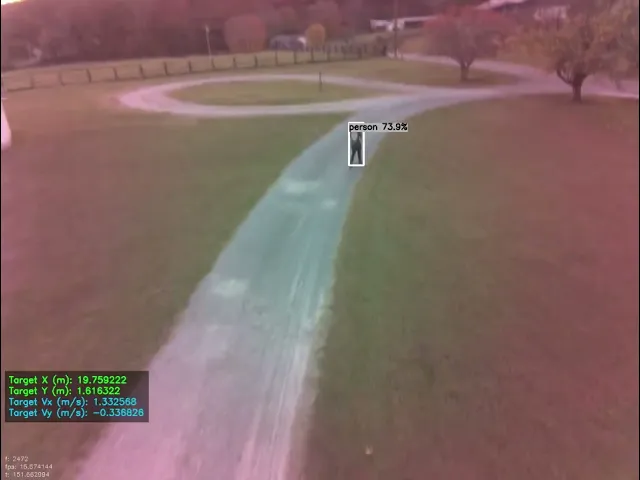
Students work with live camera input and AI object detection models, learning why raw detections alone are insufficient for control. Through filtering, prediction, and state estimation, students transform noisy, intermittent measurements into smooth target states that autonomous systems can safely act upon. Emphasis is placed on understanding uncertainty, latency, and trust—core challenges in real-world perception pipelines.
By the end of the course, students implement a complete perception-driven autonomy loop, using estimated target state to produce stable autonomous behaviors such as AI-based following. The course connects perception outputs directly to the control and navigation systems developed in earlier tracks.
Overview
This course focuses on how autonomous flight systems perceive the world and convert raw sensor data into stable, decision-ready state estimates. Building on the motion and control foundations from Track 2, students learn how perception, estimation, and control work together to enable reliable, vision-based autonomous behavior.
Students work with live camera input and AI object detection models, learning why raw detections alone are insufficient for control. Through filtering, prediction, and state estimation, students transform noisy, intermittent measurements into smooth target states that autonomous systems can safely act upon. Emphasis is placed on understanding uncertainty, latency, and trust—core challenges in real-world perception pipelines.
By the end of the course, students implement a complete perception-driven autonomy loop, using estimated target state to produce stable autonomous behaviors such as AI-based following. The course connects perception outputs directly to the control and navigation systems developed in earlier tracks.
Overview
This course focuses on how autonomous flight systems perceive the world and convert raw sensor data into stable, decision-ready state estimates. Building on the motion and control foundations from Track 2, students learn how perception, estimation, and control work together to enable reliable, vision-based autonomous behavior.
Students work with live camera input and AI object detection models, learning why raw detections alone are insufficient for control. Through filtering, prediction, and state estimation, students transform noisy, intermittent measurements into smooth target states that autonomous systems can safely act upon. Emphasis is placed on understanding uncertainty, latency, and trust—core challenges in real-world perception pipelines.
By the end of the course, students implement a complete perception-driven autonomy loop, using estimated target state to produce stable autonomous behaviors such as AI-based following. The course connects perception outputs directly to the control and navigation systems developed in earlier tracks.
Outcomes
-
Build and evaluate camera and video pipelines for robotic systems
-
Process live video input and extract AI detection measurements
-
Interpret AI detections as noisy measurements rather than direct control commands
-
Design and tune Kalman filters for target tracking and state estimation
-
Predict target motion and maintain stable estimates over time
-
Control autonomous flight behavior using estimated target state rather than raw detections
Outcomes
-
Build and evaluate camera and video pipelines for robotic systems
-
Process live video input and extract AI detection measurements
-
Interpret AI detections as noisy measurements rather than direct control commands
-
Design and tune Kalman filters for target tracking and state estimation
-
Predict target motion and maintain stable estimates over time
-
Control autonomous flight behavior using estimated target state rather than raw detections
Outcomes
-
Build and evaluate camera and video pipelines for robotic systems
-
Process live video input and extract AI detection measurements
-
Interpret AI detections as noisy measurements rather than direct control commands
-
Design and tune Kalman filters for target tracking and state estimation
-
Predict target motion and maintain stable estimates over time
-
Control autonomous flight behavior using estimated target state rather than raw detections