MAVLink Interfaces for Autonomous Systems
MAVLink Interfaces for Autonomous Systems
MAVLink Interfaces for Autonomous Systems
Overview
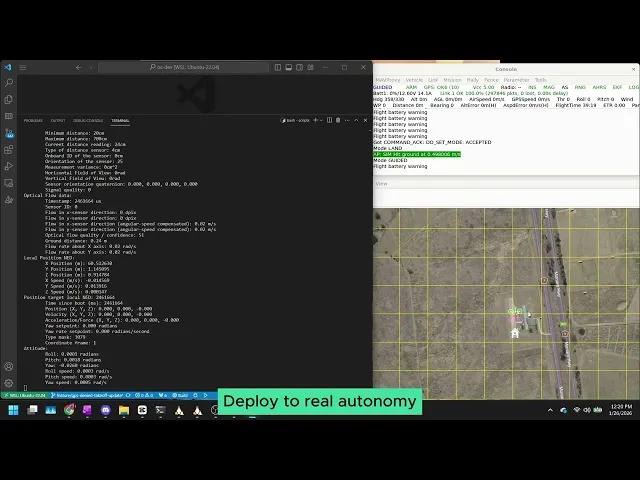
This course focuses on using MAVLink as a low-level control and telemetry interface for autonomous systems. Rather than relying on high-level SDK abstractions, students work directly with MAVLink messages to design custom command and telemetry interfaces tailored to their autonomy needs.
Students learn how to define a minimal, intentional command surface for autonomy, separating control authority from telemetry and ensuring predictable system behavior. Emphasis is placed on message timing, update rates, and failure handling—critical considerations when autonomy logic operates outside of a traditional ground control station.
By the end of the course, students are able to design and implement their own MAVLink-based interfaces, enabling custom autonomous behaviors, safety gating, and system monitoring beyond what off-the-shelf tools provide.
Overview
This course focuses on using MAVLink as a low-level control and telemetry interface for autonomous systems. Rather than relying on high-level SDK abstractions, students work directly with MAVLink messages to design custom command and telemetry interfaces tailored to their autonomy needs.
Students learn how to define a minimal, intentional command surface for autonomy, separating control authority from telemetry and ensuring predictable system behavior. Emphasis is placed on message timing, update rates, and failure handling—critical considerations when autonomy logic operates outside of a traditional ground control station.
By the end of the course, students are able to design and implement their own MAVLink-based interfaces, enabling custom autonomous behaviors, safety gating, and system monitoring beyond what off-the-shelf tools provide.
Overview
This course focuses on using MAVLink as a low-level control and telemetry interface for autonomous systems. Rather than relying on high-level SDK abstractions, students work directly with MAVLink messages to design custom command and telemetry interfaces tailored to their autonomy needs.
Students learn how to define a minimal, intentional command surface for autonomy, separating control authority from telemetry and ensuring predictable system behavior. Emphasis is placed on message timing, update rates, and failure handling—critical considerations when autonomy logic operates outside of a traditional ground control station.
By the end of the course, students are able to design and implement their own MAVLink-based interfaces, enabling custom autonomous behaviors, safety gating, and system monitoring beyond what off-the-shelf tools provide.
Outcomes
-
Use MAVLink directly as a control and telemetry interface for autonomous systems
-
Design a minimal command surface that cleanly separates autonomy control from monitoring and telemetry
-
Manage command authority and arbitration between autonomy code and external controllers
-
Select and tune MAVLink message rates, timing, and update behavior for reliable operation
-
Identify and handle MAVLink-related failure modes, including loss-of-link and degraded telemetry
-
Evaluate and validate autonomy behavior under fault conditions using simulated communication disruptions
Outcomes
-
Use MAVLink directly as a control and telemetry interface for autonomous systems
-
Design a minimal command surface that cleanly separates autonomy control from monitoring and telemetry
-
Manage command authority and arbitration between autonomy code and external controllers
-
Select and tune MAVLink message rates, timing, and update behavior for reliable operation
-
Identify and handle MAVLink-related failure modes, including loss-of-link and degraded telemetry
-
Evaluate and validate autonomy behavior under fault conditions using simulated communication disruptions
Outcomes
-
Use MAVLink directly as a control and telemetry interface for autonomous systems
-
Design a minimal command surface that cleanly separates autonomy control from monitoring and telemetry
-
Manage command authority and arbitration between autonomy code and external controllers
-
Select and tune MAVLink message rates, timing, and update behavior for reliable operation
-
Identify and handle MAVLink-related failure modes, including loss-of-link and degraded telemetry
-
Evaluate and validate autonomy behavior under fault conditions using simulated communication disruptions